
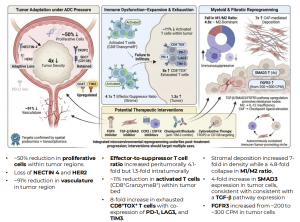
This case study examines a patient diagnosed with Urothelial Carcinoma who experienced a partial response and significant tumor reduction following Padcev (Nectin-4 ADC) therapy, though the disease ultimately persisted. Analysis revealed that post-treatment progression is driven by coordinated microenvironmental reprogramming, which includes antigen loss (NECTIN-4 and HER2), immune exhaustion, macrophage polarization, and fibrotic reprogramming. Specific markers of this resistance include a ~91% reduction in tumor vasculature and a 4.8-fold collapse in the M1/M2 macrophage ratio.
Same-slide spatial multiomic workflow: The foundational approach used by the Elucidate Biomarker Platform to analyze pre-treatment and post-treatment biopsies.
50-plex spatial proteomics: An analytical method combined with whole-transcriptome spatial transcriptomics to uncover biological mechanisms active within the same tissue architecture.
Model-guided cell detection: A computational technique utilized alongside integrated multiomic analysis to simultaneously assess tumor-intrinsic signaling, immune functional states, and stromal organization.
Mechanistic resolution: The framework applied to map specific spatial layers of resistance, such as identifying that exhausted T cells are concentrated in tumor regions, while activated T cells remain confined to stromal compartments and fail to infiltrate the tumor bed.
Download the full case study to see how the Elucidate Bio Platform provides mechanistic resolution not accessible through non-spatial approaches.
Discover how classifying tumors by dominant resistance architecture can support mechanism informed trial enrollment and the rational prioritization of therapeutic combinations for oncology drug development.
