Uncovering Mechanisms of Immune Suppression in EBV+ cHL Patients
Elucidate Bio
Case Study
March 2026
Context
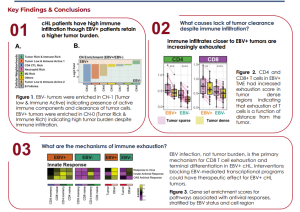
Classical Hodgkin Lymphoma (cHL) is strongly correlated with Epstein Bar Virus (EBV) infection. While EBV+ and EBV- tissues are pathologically indistinguishable and treatment is currently identical regardless of viral status, patient outcomes differ significantly. EBV+ patients over the age of 45 have a 5-year disease-free survival of only 37% versus 74% in EBV- cases. This study investigates the hypothesis that EBV infection drives specific changes in the tumor microenvironment (TME) that alter patient response to immune therapy.
Methodology
The study utilized a spatial multi-modal framework to analyze 46 cHL patient samples. The analytical approach included:
Spatial Proteomics: Identifying key cell types and their functional states.
Neighborhood Analysis: Performing cell segmentation, phenotyping, and cellular neighborhood analysis.
Systems Integration: Using multiomic data integration, receptor-ligand scoring, and spatial exhaustion scores to quantify T cell dysfunction as a function of distance from the tumor.
Download the full case study to see how the Elucidate spatial multi-modal framework dissects complex mechanisms of dysfunction to identify actionable points of intervention.
Discover how this framework can be adapted for your future studies in other disease states to uncover specific therapeutic targets that could fundamentally improve patient outcome.
Spatial Proteomics and Transcriptomics profiling uncover mechanisms active in cHL EBV+ and EBV patients that define the pathobiology of disease and dissect response to immune therapy.
Download Our Case Studies
1. Uncovering Mechanisms of Immune Suppression in EBV+ cHL Patients
2. NEW! Translating ADC Treatment Resistance to
Therapeutic Strategy in Bladder Cancer